
Also can be read here:
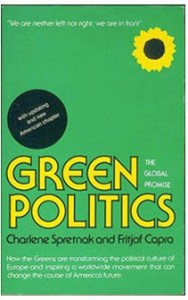 To address this historic question, Californians Charlene Spretnak and Fritjof Capra researched and wrote a definitive, early study of the West German Green Party — Green Politics: The Global Promise (New York: E. P. Dutton). Published in March 1984, the book provided deep insights into the challenges Die Grünen (the Greens) had faced as they brought together various social movements to create a new eco-social politics and to form a new kind of party that brings the values and analyses of the social movements into the bodies of government and brings information about the workings of government out to the movements. After winning seats in local and state governments – and after making an impressive showing in the West German election for the European Parliament in 1979 – the West German Greens won 27 seats in the German Parliament in 1983. The book Green Politics, which was based on 60 interviews with German Greens conducted by Spretnak plus six by Capra, was translated into German, Italian, and Japanese. It conveyed to an American audience the Four Pillars of the West German Green Party: ecology, social justice, grassroots democracy, and non-violence. In addition, the Green parties in Canada, Britain, elsewhere in Europe, and New Zealand and Australia were discussed.
The book bore an endorsement from Petra Kelly (a co-founder of Die Grünen and then-Co-Speaker of the West German Green Party): “to American readers who want to know what is at the heart of alternative Green Party politics.” Green Politics received several positive reviews in American newspapers and became a primer for those seeking to start a Green Party in the United States. The final chapter, “The Green Alternative – It Can Happen Here” inspired many to believe that this was possible, even during the depths of the Reagan years. Indeed, only six months after Green Politicswas published and became a catalyst, the Founding Conference of the Green Politics movement in the United States was held.
- Table of Contents
- Introduction
- First Stirrings of a Green Political Party in the United States
- Green Politics: The Global Promise
- Early Outreach to the Bioregional Movement
- The Founding of U.S. Greens – St. Paul, MN, August 1984
- Creation of the Ten Key Values
- National Clearinghouse
- Early Debates About Green Issues
- First National Green Gathering – Amherst, MA, 1987
- Strategy & Policy Approaches in Key Areas (SPAKA)
- Greening the West Gathering – near San Francisco, 1988
- Second National Green Gathering – Eugene, OR, 1989
- Early State Party Ballot Qualification Efforts and Candidacies
- Third National Green Gathering – Estes Park, CO, 1990
- Green Party Organizing Committee – Boston, 1991
- Fourth National Green Gathering – Elkins, WV, 1991
- Green Politics Network – 1992
- Fifth National Green Gathering – Minneapolis, 1992
- Electoral Success in 1992 and Post-Election Conferences in Santa Monica and at Bowdoin College, February 1993
- 1995 – A Watershed Year for Green Party Development: The Third Parties ’96 Conference, and the Nader Factor
- National Green Gathering ’95 – Albuquerque, NM 36
- First Green Presidential Nominating Convention – UCLA, 1996; Nader’s 1996 Campaign for President as the Green Party Candidate
- Association of State Green Parties (ASGP) – 1996
- 2000 Presidential Candidate Outreach
- Green Party Presidential Nominating Convention 2000 and Nader 2000
- The Boston Proposal – October 2000
- Founding of the Green Party of the United States – July 2001
- National Committee Status Granted to the Green Party of the United States by the Federal Election Commission, 2001
 Green Party Elders